Ethical Publishing in Biodiversity Conservation Science

For many researchers, particularly in academia, publishing in peer-reviewed journals is a necessity, with major implications for their career progression. Yet, it is increasingly recognised that the current scientific publishing model is not fair and equitable, which can have severe consequences for the way science is accessed and used in nature conservation. We evaluated the publishing model of 426 conservation science journals against the Fair Open Access (FOA) principles.

Two-thirds of journals, together publishing nearly half of all articles, complied with only two or fewer FOA principles. Only twenty journals (5%), publishing 485 articles per year (<1%), complied with all five principles. We uncovered a weak negative correlation between journal impact factor and the number of FOA principles fulfilled.

Figure 1: Publications fulfilling different Fair Open Access principles. (a) Number of Journals. (b) Number of Articles associated with those Journals

Lastly, we found that Elsevier, Wiley, Taylor & Francis, and Springer represented 48% of all journals, but 80% of the 25 journals with the highest impact factor. Our results show that conservation science journals largely fail to meet the FOA standards. Conservation researchers are likely to face obstacles such as limited access to published literature, high publishing charges, and lack of ownership of their research outputs.

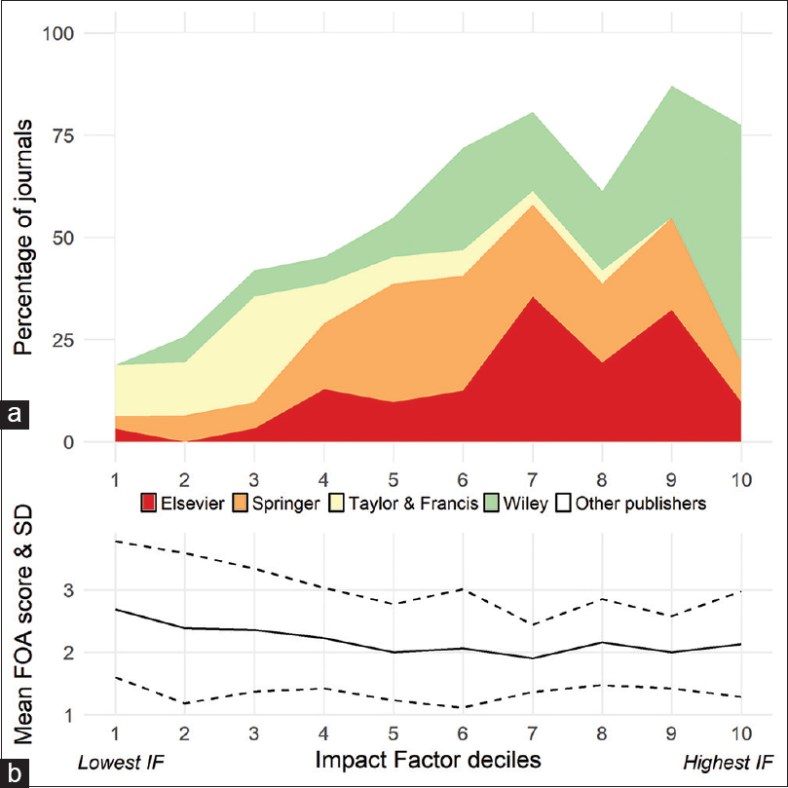
Figure 3: Impact Factor Scores. (a) Proportion of journals with an impact factor belonging to the four main academic publishers: Springer, Wiley, Taylor & Francis and Elsevier. (b) Mean Fair Open Access score of journals with different impact factors (as assigned in 2017)

To help authors make more informed decisions we made a database of 400+ journals with each journal ranked according to the Fair Open Access Criteria.
Ethical considerations when conservation research involves people

In 2018, I was privileged to participate in the Interdisciplinary Conservation Network – a biennial workshop organised and run by early career researchers. My colleagues Stephanie Brittain and Harriet Ibbett facilitated an excellent discussion on the ethical challenges faced by early career researchers in conservation science. All social research has ethical challenges, but conservation is particularly fraught given it’s colonial history and the huge areas of contested land that conservation aims to manage. I found this to be a therapeutic venue to discuss ethical dilemnas I have encountered in the field, and I’m very proud of the paper we subsequently published in Conservation Biology.

Abstract

Social science is becoming increasingly important in conservation, with more studies involving methodologies that collect data from and about people. Conservation science is a normative and applied discipline designed to support and inform management and practice. Poor research practice risks harming participants, researchers, and can leave negative legacies. Often, those at the forefront of field‐based research are early‐career researchers, many of whom enter their first research experience ill‐prepared for the ethical conundrums they may face. Here, we draw on our own experiences as early‐career researchers to illuminate how ethical challenges arise during conservation research that involves human participants. Specifically, we discuss ethical review procedures, conflicts of values, and power relations, and provide broad recommendations on how to navigate ethical challenges when they arise during research. We encourage greater engagement with ethical review processes and highlight the pressing need to develop ethical guidelines for conservation research that involves human participants.

Integrating models of human behaviour between the individual and population levels to inform conservation interventions

Abstract

The Open Access text is available here.

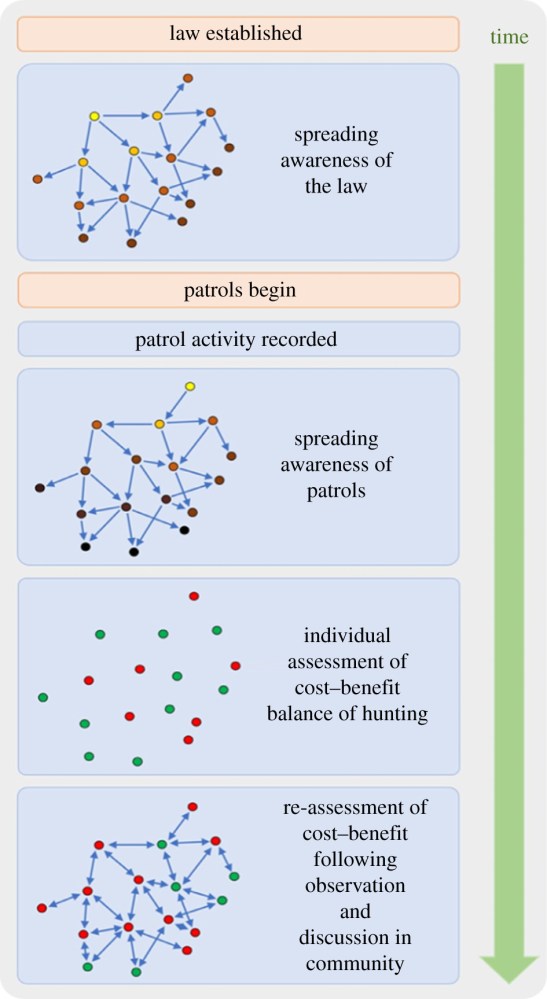
Conservation takes place within social–ecological systems, and many conservation interventions aim to influence human behaviour in order to push these systems towards sustainability. Predictive models of human behaviour are potentially powerful tools to support these interventions. This is particularly true if the models can link the attributes and behaviour of individuals with the dynamics of the social and environmental systems within which they operate. Here we explore this potential by showing how combining two modelling approaches (social network analysis, SNA, and agent-based modelling, ABM) could lead to more robust insights into a particular type of conservation intervention. We use our simple model, which simulates knowledge of ranger patrols through a hunting community and is based on empirical data from a Cambodian protected area, to highlight the complex, context-dependent nature of outcomes of information-sharing interventions, depending both on the configuration of the network and the attributes of the agents. We conclude by reflecting that both SNA and ABM, and many other modelling tools, are still too compartmentalized in application, either in ecology or social science, despite the strong methodological and conceptual parallels between their uses in different disciplines. Even a greater sharing of methods between disciplines is insufficient, however; given the impact of conservation on both the social and ecological aspects of systems (and vice versa), a fully integrated approach is needed, combining both the modelling approaches and the disciplinary insights of ecology and social science.

Improving environmental interventions by understanding information flows

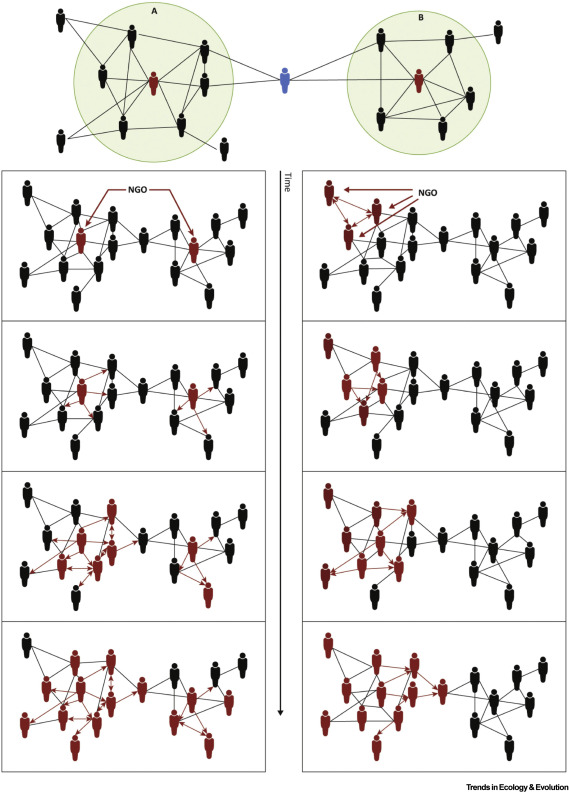
I’m very pleased to share our latest publication: a review on the role of information flows in conservation interventions, published in the journal Trends in Ecology & Evolution. The Open Access text is available here.

An animated summary of a figure from our paper

Abstract

Conservationists are increasingly interested in changing human behaviour. One understudied aspect of such interventions is information flow. Different patterns of interpersonal communica-tion and social structures within communities influence the adoption of behavioural changes through social influence and social reinforcement. Understanding the structure of information flow in a group, using tools such as social network analysis, can therefore offer important insights for interventions. For example, communications may be targeted to highly connected opinion leaders to leverage their influence, or communication may be facilitated between distinct subgroups to promote peer learning. Incorporating these approaches into conservationinterventions can promote more effective behaviour change. This review introduces conservation researchers and practitioners to key concepts underpinning information flows for interventions targeting networks of individuals.

Approaches Used to Evaluate the Social Impacts of Protected Areas

The Open Access text is available here. This paper is a version of my undergraduate thesis at Imperial College London.

Abstract

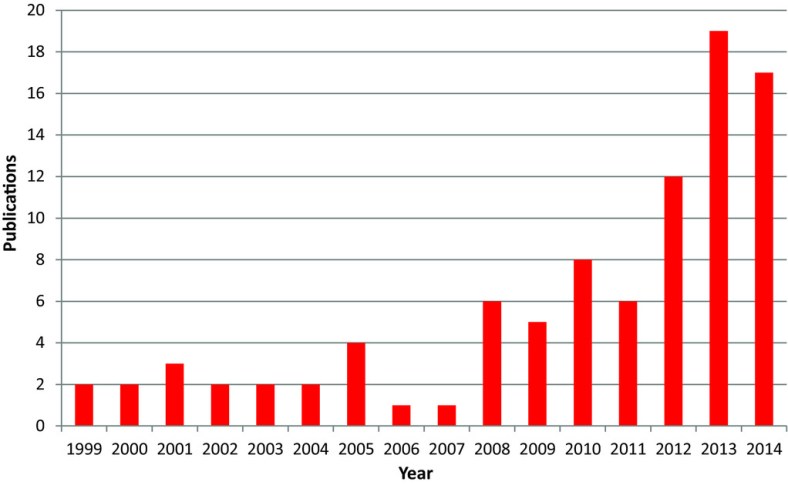
Protected areas are a key strategy in conserving biodiversity, and there is a pressing need to evaluate their social impacts. Though the social impacts of development interventions are widely assessed, the conservation literature is limited and methodological guidance is lacking. Using a systematic literature search, which found 95 relevant studies, we assessed the methods used to evaluate the social impacts of protected areas. Mixed methods were used by more than half of the studies. Almost all studies reported material aspects of wellbeing, particularly income; other aspects were included in around half of studies. The majority of studies provided a snapshot, with only one employing a before‐after‐control‐intervention design. Half of studies reported respondent perceptions of impacts, while impact was attributed from researcher inference in 1/3 of cases. Although the number of such studies is increasing rapidly, there has been little change in the approaches used over the last 15 years, or in the authorship of studies, which is predominantly academics. Recent improvements in understanding of best practice in social impact evaluation need to be translated into practice if a true picture of the effects of conservation on local people is to be obtained.