I was quoted in this article on Dialogue Earth.
April 17, 2024
Cambodia’s reliance on microloans, long touted as a way to reduce poverty, belies concerns over debt-fuelled deforestation

In Cambodia’s Prey Lang Wildlife Sanctuary, spanning 490,000 hectares, expansive tracts of protected forest are being illegally converted to cassava, cashew and rubber plantations.
Husband and wife Piseth and Sokheng (names changed) began cultivating cassava to repay a USD 10,000 loan from AMK Microfinance Institution, following the collapse of their mango business. Cultivating cassava, a quick-growing crop, facilitated his family’s monthly repayments, which exceeded USD 200, as they waited for their cashew trees to bear fruit.
“I needed money to buy seedlings to plant cassava here and some for my cashew farm in my hometown,” says Piseth, who lives in a village just south of the Prey Lang border, in Kratie province. “If we didn’t owe the microfinance organisation, we wouldn’t have come here.”
Piseth’s situation reflects a trend in Cambodia where farmers, reliant on microloans to compensate for crop failures or to invest in their small farms, become locked in a cycle of debt and resort to illegal land conversion. Deforestation, driven by the need to honour microloan commitments, is causing alarm among conservation groups.
“Microfinance alone isn’t responsible for conservation problems, but it is a kind of threat multiplier,” says Wildlife Conservation Society (WCS) researcher Emiel de Lange, indicating the complex dynamics at play.
Deeper inside the sanctuary, makeshift shelters dot the landscape, where deforestation is rampant. In 2022 alone, Global Forest Watch data showed a loss of approximately 8,300 hectares in Prey Lang, mirroring a decades-long national crisis, in which over a quarter of Cambodia’s forests have disappeared since 2000.
Microlenders under the microscope
Predominantly driven by government concessions for mining, timber extraction and large-scale agriculture, deforestation in Prey Lang is compounded by illegal logging and corruption. But in the last decade, smallholder farmers like Piseth, with less than 10 hectares of land, have emerged as significant contributors to the issue amid growing land insecurity, says Cambodia-based geo-agronomist Jean-Christophe Diepart.
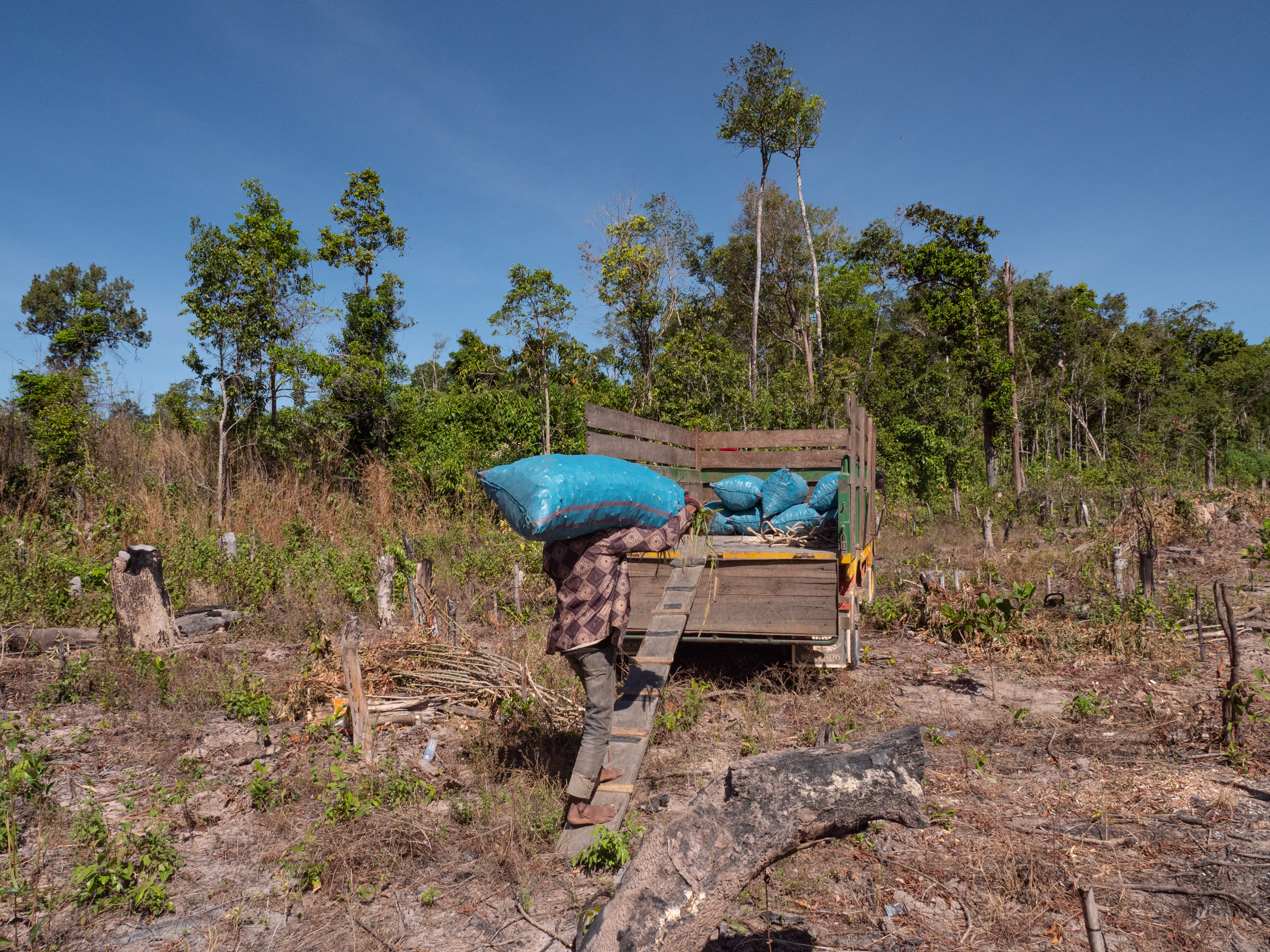
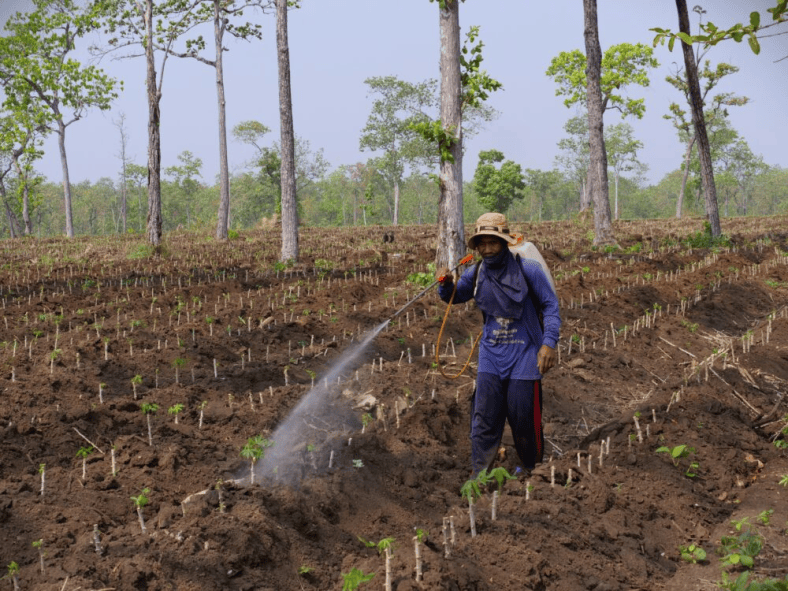
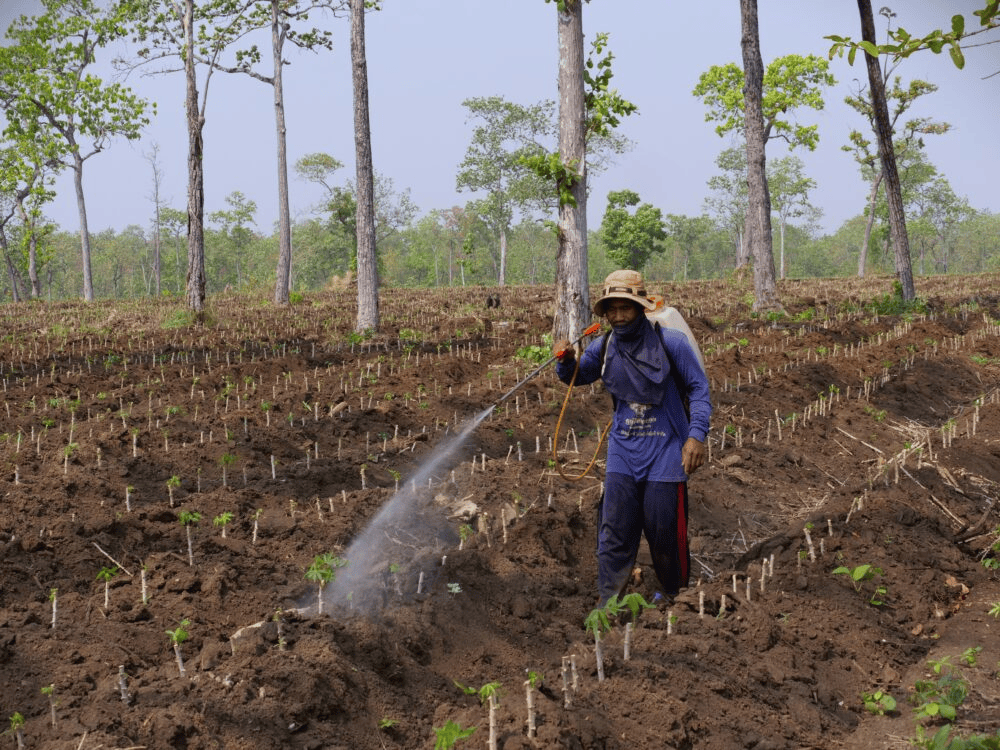
Illegal growing of cassava in Prey Lang Wildlife Sanctuary is commonly used to repay microloan debt, intensifying forest clearance (Image: Jack Brook)
Microloan debt in Cambodia doubled from USD 8 billion to USD 16 billion between 2019 and 2023, resulting in the highest number of microfinance borrowers per capita globally. While advocates claim that access to small-scale enterprise funding has lifted many Cambodians out of poverty, its effectiveness is disputed.
The scale of microloans in Cambodia
There were 3.06 million active microloans in 2022, in a country of 3.6 million households, states the Cambodia Microfinance Association.
Economic pressures from crop failures and unforeseen expenses can push farmers into debt, prompting land sales. In the last five years, over 165,000 debt-fuelled transactions were recorded. For people living in or near protected areas, “the logic will then be to try to clear additional land” to plant more crops, Diepart explains.
Concerns about predatory lending practices have led the ombudsman for the International Finance Corporation (IFC) – the World Bank Group’s private sector development subsidiary – to probe investments in Cambodia’s top microlenders worth hundreds of millions of dollars.
Although Cambodia’s microfinance sector remains a magnet for western development agencies attracted by “green finance” opportunities, such as sustainability bonds aimed at funding environmentally friendly projects, concerns persist. The US Agency for International Development (USAID), which recently launched a USD 24 million conservation programme in Cambodia, tells Dialogue Earth that for many communities, household debt is a “major issue impacting their economic wellbeing”.
Kaing Tongngy, spokesperson for the Cambodia Microfinance Association (CMA), told Dialogue Earth its members are prohibited from funding activities “directly or indirectly involving the act of deforestation, forest destruction and forest clearing”. But the evidence reveals a disconnect between policy and practice on the ground.
A village full of debt, devoid of trees
In the south-western province of Kampong Speu, bordering Cardamom National Park and Aural Wildlife Sanctuary, residents of Kteh village also face financial struggles. Sreyneang (name changed) and her husband borrowed money to renovate their house and purchase a tractor known as a koyun. Overwhelmed by debt, they turned to illegal logging.
“We cut logs, like most people, because we need money to repay the microfinance loan,” she says. Their predicament is a familiar one in the village, where ten other households, mostly AMK borrowers, shared similar experiences with Dialogue Earth. To secure loans, many villagers had used their homes and farmland as collateral.
AMK says it has 62 clients in Kteh, each with an average loan size of USD 3,766. AMK’s legal manager, Sao Elen Chhe, told Dialogue Earth that the company is committed to “thorough due diligence” and that it “prohibits financing activities that could have negative environmental or social impacts”. However, village testimony obtained by Dialogue Earth contradicts this claim.
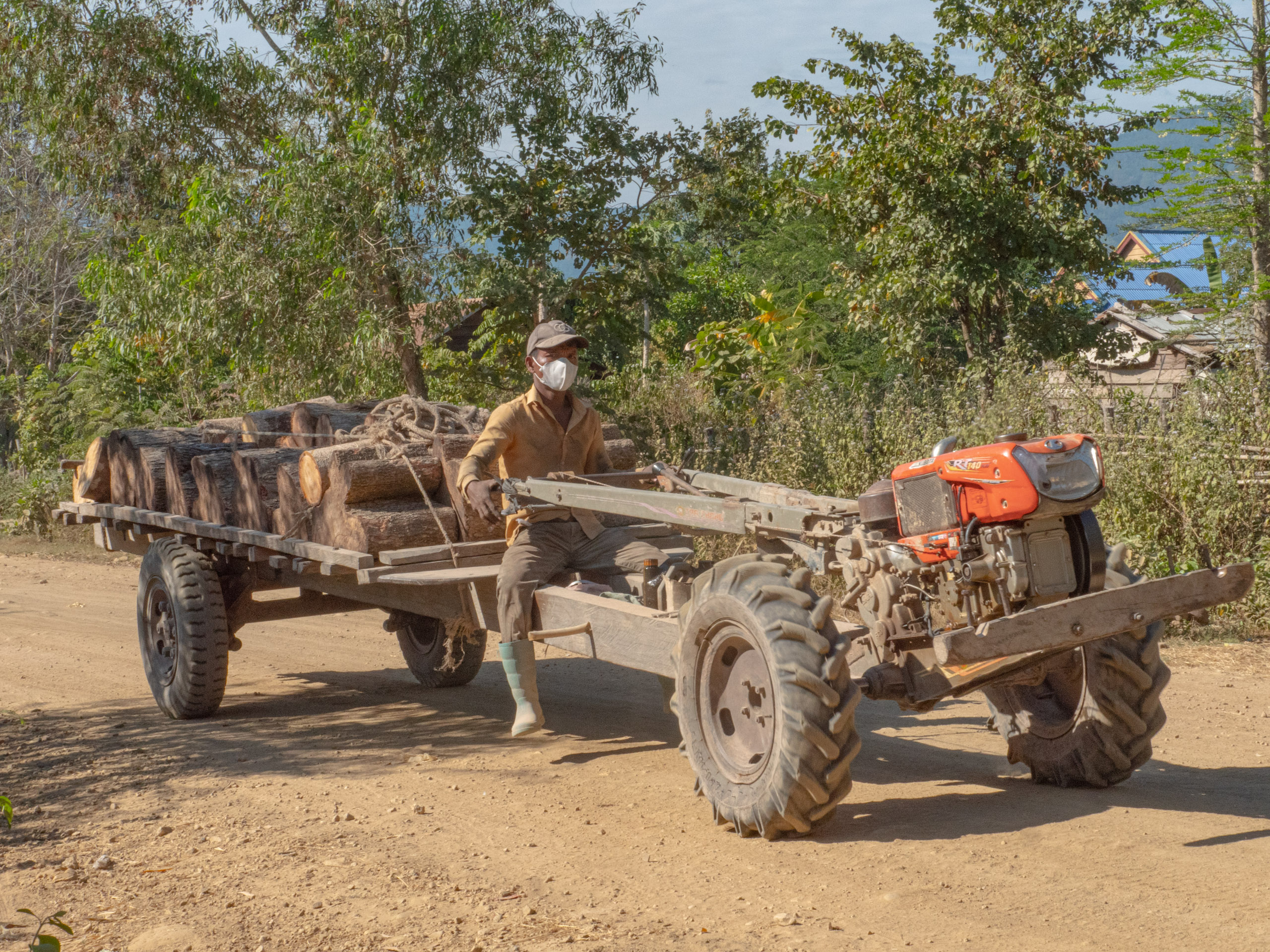
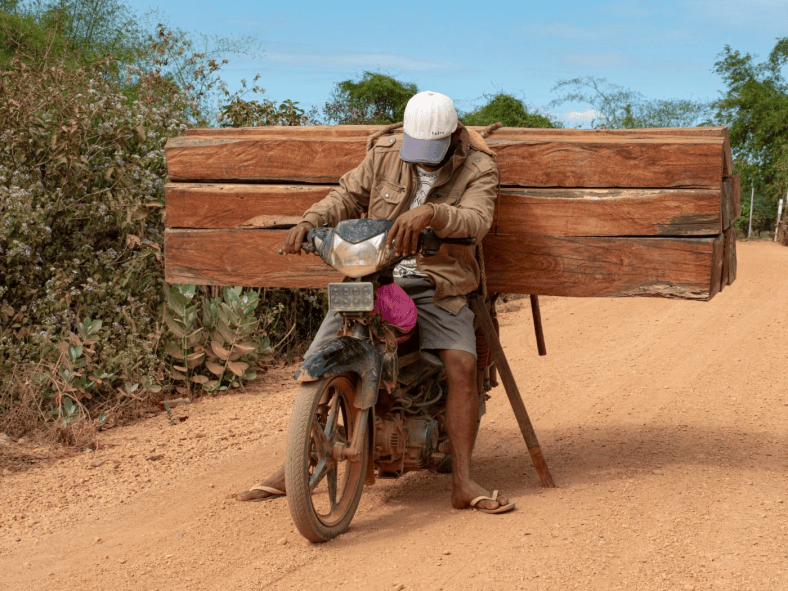
In Kampong Speu province, a man transports logs on a koyun through Kteh village, where residents rely on logging to repay microloan debts (Image: Jack Brook)
The Belgian Investment Company for Developing Countries (BIO), a government institution, issued a USD 15 million loan to AMK last July, emphasising strict environmental compliance. In response to Dialogue Earth’s queries, BIO claimed that borrowers in Kteh did not violate its policies as they “derive their income from charcoal trading”, which “traditionally uses small trees or branches and does not rely on the cutting of virgin forest or other logging activities”. But this is at odds with village chief Lim Him’s observations.
Him maintains that while some villagers cut trees on their farms, many engage in illegal forest clearance in protected conservation areas. He is unaware of specific involvement in charcoal production. Instead, villagers sell the timber to middlemen, some of whom distribute it to garment factories or large-scale charcoal production sites. Villagers openly acknowledge to Dialogue Earth the illegality of their actions to repay loans; their testimony backed by giant stacks of freshly cut logs piled outside their homes.
“They know logging is illegal, but they have no choice since they are defaulting on their microloans,” says Him. There are scant economic alternatives to forest exploitation, with lenders and bilateral development partners seemingly ignoring the destructive activity fuelled by these loans, he notes.
Systemic oversight failures worsen the problem
Marcus Hardtke, an environmentalist with over 20 years of experience in Cambodian conservation, says there is blatant disregard by authorities of rampant illegal-logging activities for charcoal production serving the capital Phnom Penh and beyond. Hardtke tells Dialogue Earth that the charcoal trade is synonymous with the “organised illegal logging” afflicting protected forests near Kteh, to which “the authorities turn a blind eye”.
Before BIO’s loan to AMK was authorised, Cambodian human rights NGO LICADHO met with the Belgian government and “specifically warned them that further investments without safeguards were guaranteed to cause harms,” says Naly Pilorge, its outreach director. These outcomes “absolutely should have been foreseen,” she adds.
In Tonsaong Thleak village, near Prey Lang, microloans also perpetuate a cycle where logging serves as both employment and debt repayment, despite legal repercussions. A supposed reforestation concession belonging to Holy Plantation, a firm formerly named Think Biotech, was at the centre of an illegal timber-laundering network implicating villagers. The arrest of villager Phlaok Kroeurn’s son and son-in-law for transporting logs allegedly as part of this network reflects the potential consequences: penalised by the law, yet abandoned by the companies that profit from their plight.
“The company hired my son to do the work, but when he was arrested, they didn’t try to help him,” Kroeurn says. Both family members had taken loans from microfinance company LOLC Cambodia to purchase koyuns for log transportation. Holy Plantation’s chairperson denies connections to illegal logging or to Kroeurn’s relatives.
Debt a threat to conservation
Srea Preah is a 3,438-hectare community-protected area within the Keo Seima Wildlife Sanctuary, in the north-eastern province of Mondulkiri. Today, less than half of that area is still forested. Despite efforts from WCS’s REDD+ carbon offset project, launched in 2016 to curb deforestation, forest clearance has accelerated on its periphery, particularly in Sre Preah. This has led to increased land insecurity and diminished financial gains for the Indigenous Bunong communities who live nearby and receive payments through the REDD+ project to protect the forest.https://flo.uri.sh/visualisation/17585512/embed
Deforestation in Sre Preah stems mainly from illegal farming settlements that emerged after 2014. While these settlements were recently acknowledged by authorities, they had long claimed land titles to collateralise microloans, in apparent violation of Cambodian law, according to WCS. Alistair Mould, WCS Cambodia director, explains that as the area is classified as a sustainable use zone, land titles for these plots are prohibited. Despite this, microloans are “intensifying the expansion of agriculture in the area”, he adds.
Cambodia’s Ministry of Environment, responsible for Sre Preah and other protected areas, did not respond to requests for comment.
Sre Preah: From protected area to farmland
Despite formal restrictions, microfinance institutions AMK, LOLC and banks like Sathapana, Woori and KP Prasac have actively issued loans within the protected area, as evidenced by loan documents reviewed by Dialogue Earth.
Um Thon, a community representative for a frontier settlement inside the forest, notes the prevalence of microfinance lenders in the village, often requiring land titles as collateral. “People need the loans to buy herbicide, fertiliser and cassava stems,” notes Thon, who says he obtained his first AMK loan to farm inside the protected forest in 2019.
Although French investor Proparco, a subsidiary of the French Development Agency, denies funding its client Sathapana’s activities in Sre Preah, loan documents held by farmers inside the protected forest suggest otherwise and also implicate LOLC.
Documents seen by Dialogue Earth show that in early 2023, Thon secured a USD 50,000 loan from Sathapana to build a large home and purchase five hectares of land for rubber planting inside Sre Preah. Records show he also used the funds to settle previous debts from Woori, Sathapana and AMK.
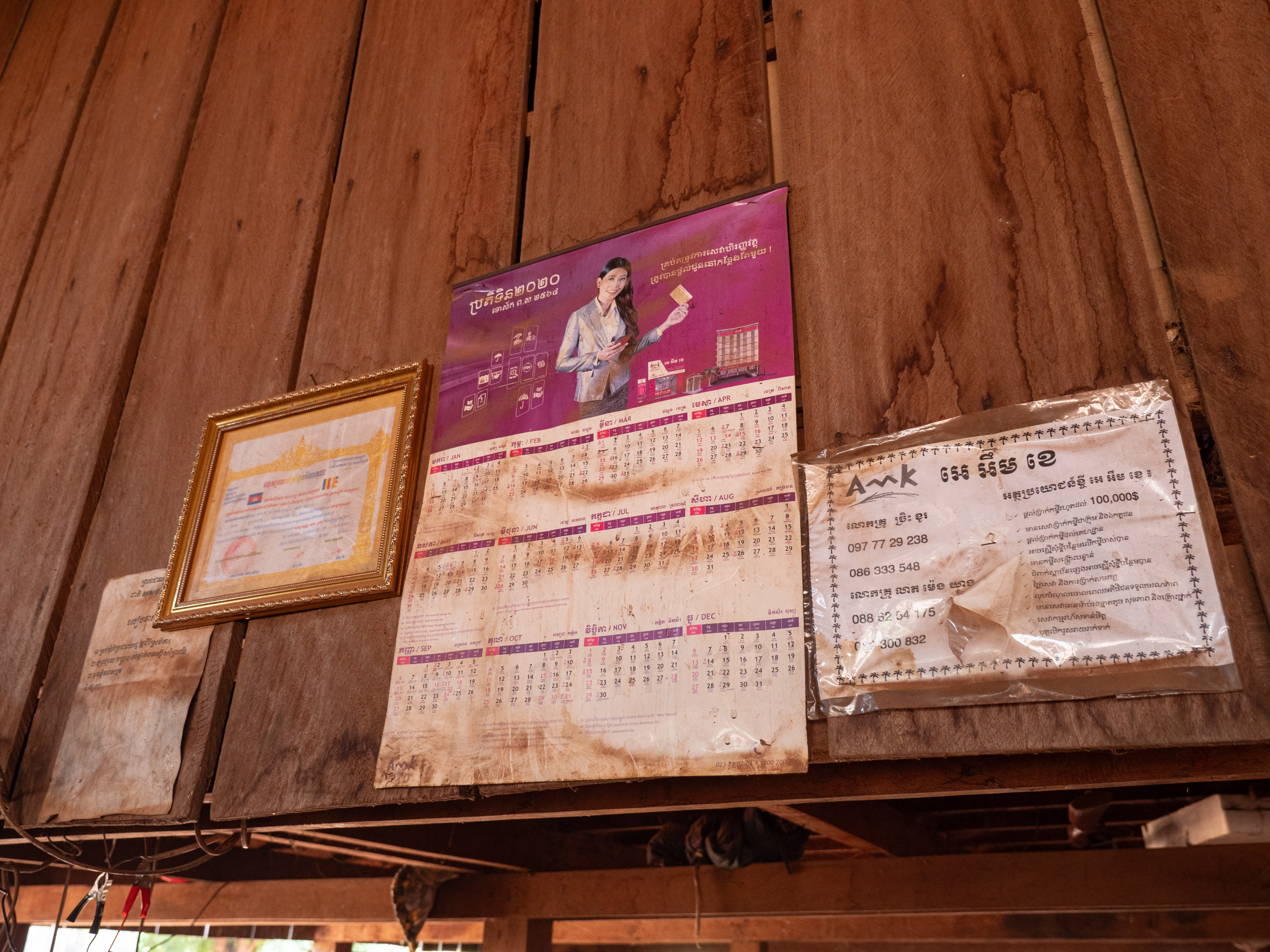
An AMK calendar from 2020 hangs inside a frontier household in the middle of the Sre Preah protected area. The year indicates lenders were issuing microloans to farmers before their illegally cleared farm plots gained recognition from the authorities in November 2022. (Image: Jack Brook)
Sre Preah commune chief, Poeub Pe, responsible for verifying land titles, says numerous borrowers have long used land within the protected area as loan collateral. Some locals allege paying USD 250 for informal land titles to secure loans – a claim Pe denies.
Indigenous communities at risk
Debt has also surged among the 20 primarily Indigenous Bunong communities in and around Keo Seima. A June 2023 WCS study found USD 13.2 million in loans were secured against land across the REDD+ project area; household debt increased tenfold from USD 358 in 2012 to USD 3,656 in 2023, with over half the villagers saddled with microloan debt. However, the majority of Indigenous communities in Keo Seima have either received or are in the process of finalising Indigenous Communal Land Titles. These deeds prohibit microlenders from using an Indigenous villager’s residential or farmland as collateral once the titling process begins.
CMA told Dialogue Earth its microlenders are “regularly reminded” not to fund activity that undermines Indigenous land rights and cultural heritage, while AMK said it “does not knowingly” provide loans using protected Indigenous Communal Land Titles as collateral.
To reduce dependence on microloans, WCS has channelled over USD 1 million in REDD+ revenue to fund community development. These initiatives include healthcare subsidies and the establishment of community savings groups – though available funds are still minimal compared to those offered by microlenders.
“This is a problem that’s much bigger than conservation,” says de Lange. “It requires a much larger effort involving government stakeholders and the microloan industry to effectively tackle these issues.”
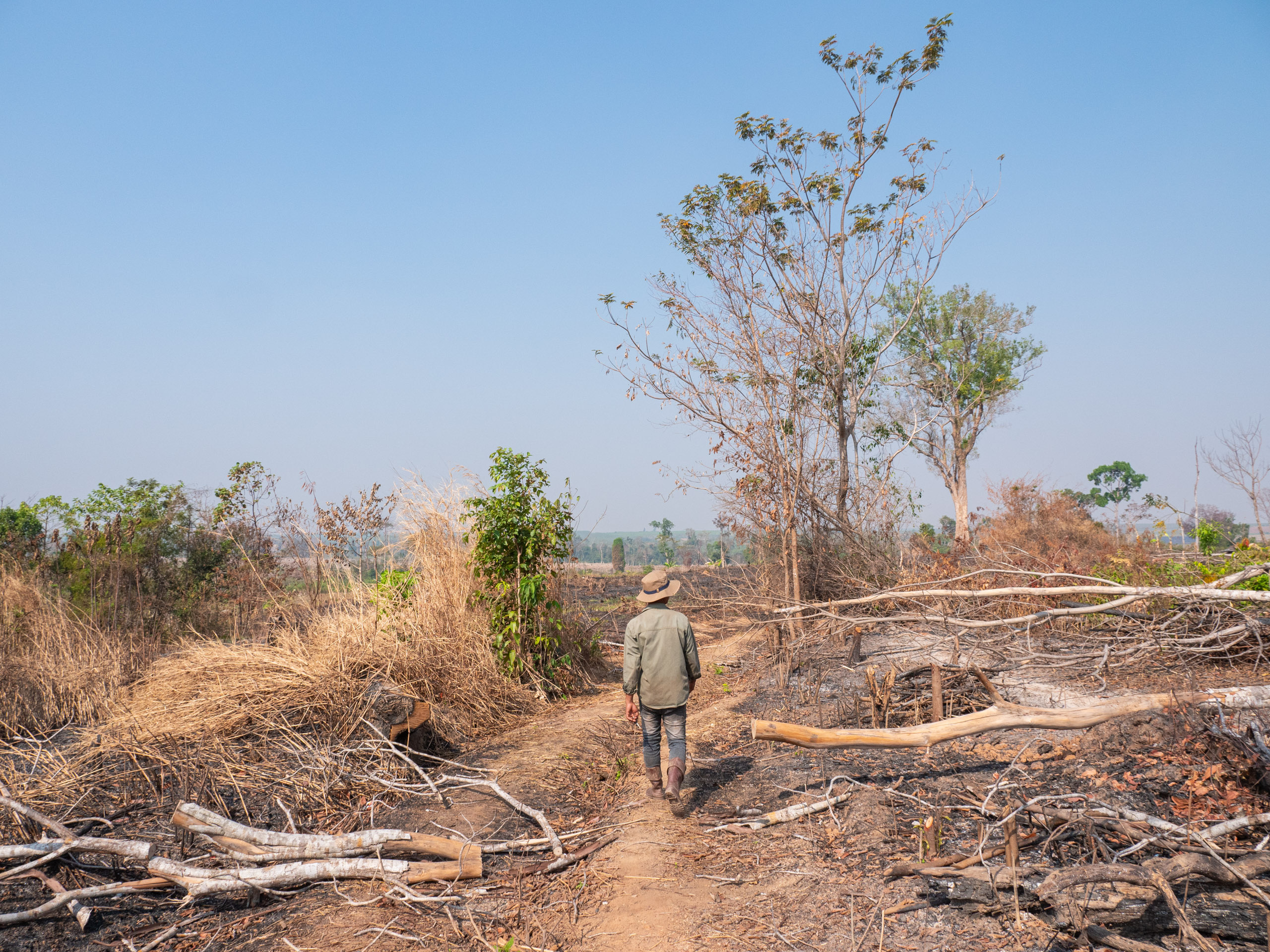
Patrols by local villagers in the Sre Preah protected area have little power to stop the rampant deforestation (Image: Jack Brook)
Niv Kanong, an Indigenous Bunong villager leading community patrols in the Sre Preah community protected area, highlights the problem of lax law enforcement by government authorities:
“Law from authorities comes only from their mouth, but when it comes to taking legal action, it is useless,” Kanong says. “In less than a year, the whole Sre Preah forest will be razed to the ground.”